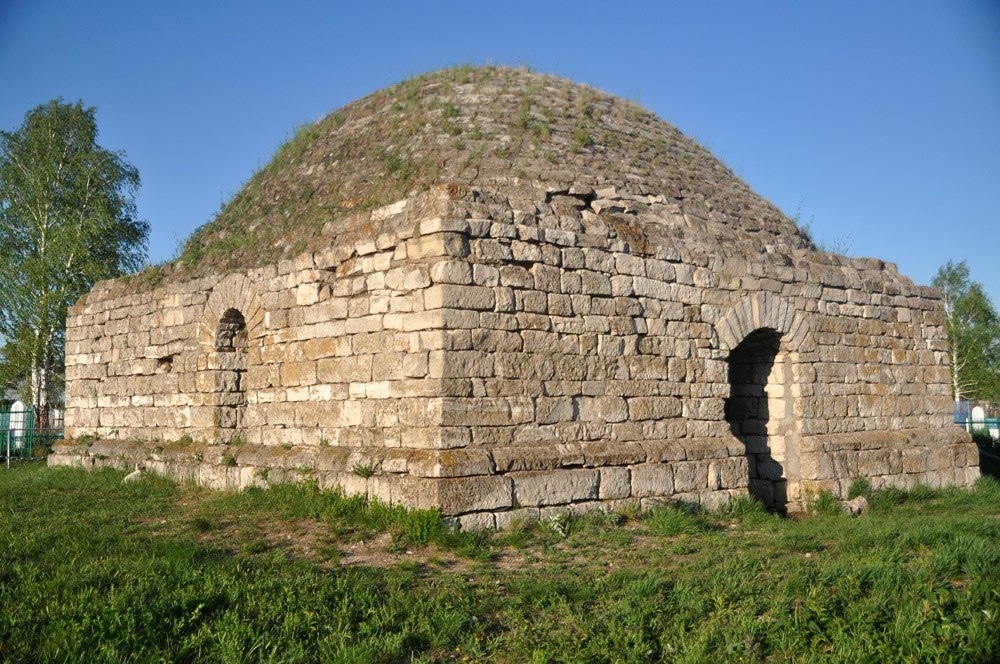
On the outskirts of the village of Chishmy lies a unique monument of medieval Islamic architecture – the Hussein-bek Mausoleum, dating back to the 14th century. Situated in the sacred Akziyarat cemetery (which translates to "White, Holy Cemetery"), the mausoleum was almost completely destroyed by the 18th-19th centuries: domes had collapsed, walls stood in ruins, and stone debris had buried ancient alabaster tombstones. Despite this, local residents revered the site as a shrine for centuries.
The mausoleum's new life began in 1911, initiated by Mufti Mukhamedyar Mukhametsharipovich Sultanov. Through community funds and donations from believers, the ruins were carefully reconstructed. Builders cleared the ancient foundation, reinforced the walls using local limestone, and recreated the building's appearance.
The restored structure is characterized by monumental simplicity: walls are constructed from meticulously fitted stones laid with clay mortar. From its original splendor, akin to the nearby Tur-khan Mausoleum, a restrained power remains, emphasizing the sacredness of the place.
Soon, the ancient Muslim monument will undergo restoration. Experienced specialists, authorized to work with cultural heritage sites, will be involved in the preservation efforts of the Hussein-bek kashane.
In the 1980s, archaeologists identified nine burials inside the mausoleum. Three simple grave pits contained the remains of adults – two men (burial #1 – Hussein-bek, burial #7) and one woman (burial #2). The name of one of the interred, Khadji Hussein-bek, son of Omar-bek from Turkestan, who passed away in 1339, has reached us thanks to the epitaph on the tombstone erected in the mausoleum. All other burials are of children. One of them was an adolescent.
The mausoleum, as the burial place of the first imam of the Bashkirs, the preacher of Islam Hussein-bek, is a revered Muslim shrine, an architectural monument, and a federal cultural heritage site.
Source: Garustovich G.N., Nechvaloda A.I. Medieval Stone Mausoleums of Bashkortostan. - Ufa, Kitap, 2020. - 400 p.
The mausoleum's new life began in 1911, initiated by Mufti Mukhamedyar Mukhametsharipovich Sultanov. Through community funds and donations from believers, the ruins were carefully reconstructed. Builders cleared the ancient foundation, reinforced the walls using local limestone, and recreated the building's appearance.
The restored structure is characterized by monumental simplicity: walls are constructed from meticulously fitted stones laid with clay mortar. From its original splendor, akin to the nearby Tur-khan Mausoleum, a restrained power remains, emphasizing the sacredness of the place.
Soon, the ancient Muslim monument will undergo restoration. Experienced specialists, authorized to work with cultural heritage sites, will be involved in the preservation efforts of the Hussein-bek kashane.
In the 1980s, archaeologists identified nine burials inside the mausoleum. Three simple grave pits contained the remains of adults – two men (burial #1 – Hussein-bek, burial #7) and one woman (burial #2). The name of one of the interred, Khadji Hussein-bek, son of Omar-bek from Turkestan, who passed away in 1339, has reached us thanks to the epitaph on the tombstone erected in the mausoleum. All other burials are of children. One of them was an adolescent.
The mausoleum, as the burial place of the first imam of the Bashkirs, the preacher of Islam Hussein-bek, is a revered Muslim shrine, an architectural monument, and a federal cultural heritage site.
Source: Garustovich G.N., Nechvaloda A.I. Medieval Stone Mausoleums of Bashkortostan. - Ufa, Kitap, 2020. - 400 p.