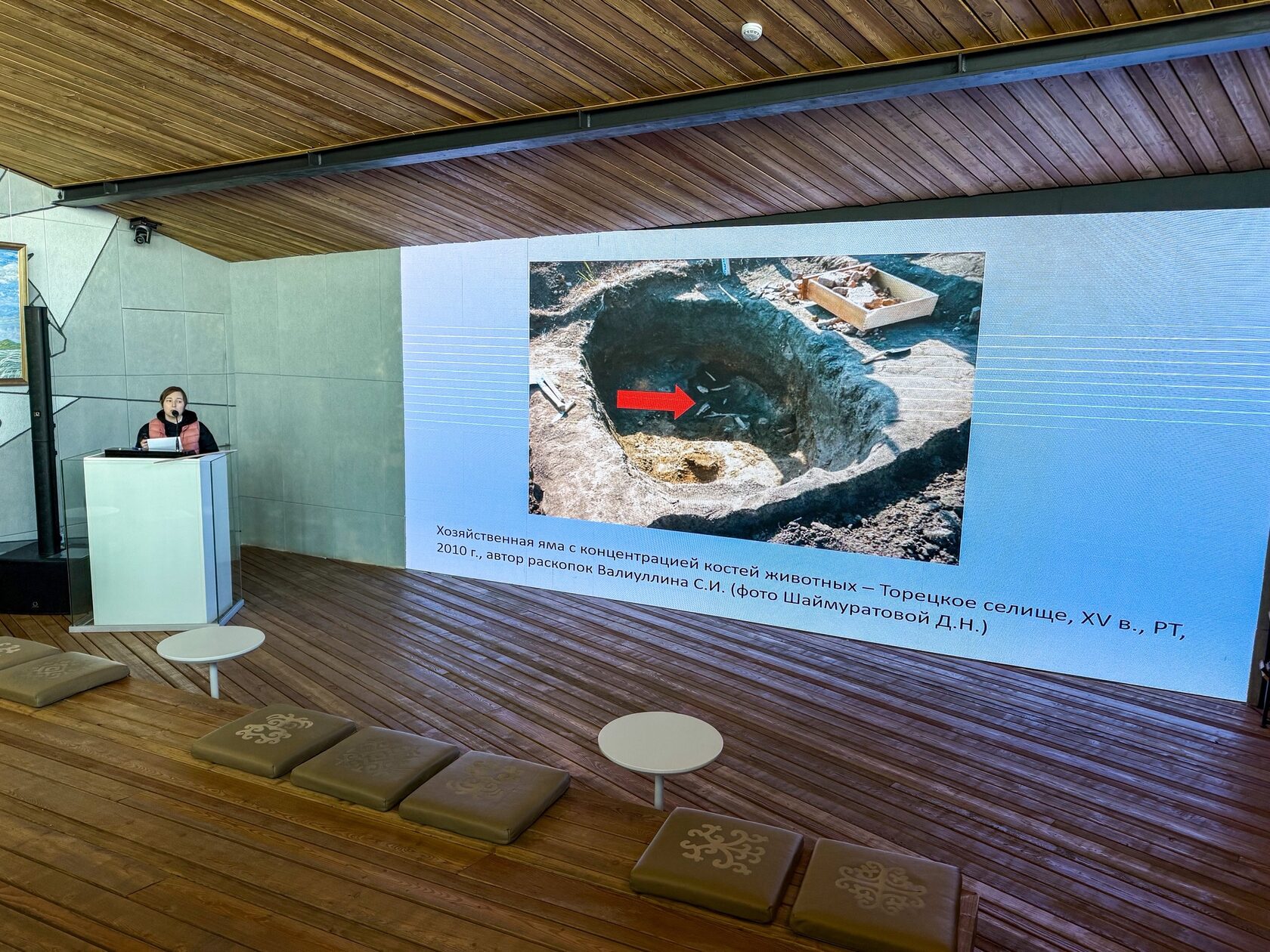
Dilyara Nailevna demonstrated how scientists can uncover very interesting facts using natural science methods, specifically archaeozoology. A significant finding was the discovery of a large concentration of goshawk bones in the 2022 excavation, belonging to 26 individuals. Furthermore, both individual bones and anatomically associated bone groups (ABGs) – up to 6 bones from one individual – were identified.
This local concentration of goshawk bones is the first of its kind recorded at archaeological sites of the Golden Horde era in Russia. Birds of prey are not consumed for food, and the accumulation of their remains may indicate other uses. The archaeological potential of the settlement has not been fully explored. It is hypothesized that the study of materials from the 2023, 2024, and 2025 excavations will confirm the hypothesis of an elite occupation among the settlement's inhabitants – falconry with goshawks. In this regard, it is worth recalling that Bashkirs actively engaged in falconry until the 19th century.
The results of studying the bones of other birds also generated interest. At the Podymalovo settlement, remains of 18 species of wild birds were found, as well as 3 species of domestic birds – chicken, goose, and duck, with geese being predominant. By examining the age composition of the birds, researchers concluded that people raised domestic birds on-site. The inhabitants also hunted capercaillie, black grouse, river ducks, and grey partridge.
The diet of the settlement's inhabitants also included fish, as evidenced by the bones of various fish species such as sevruga, beluga, sterlet, crucian carp, roach, catfish, and others. The largest fish could reach lengths of 1.8 to 3 meters. Considering the distance from major waterways, the settlement's economic zone had quite extensive boundaries.
Thus, archaeozoological research of the osteological collection from the Podymalovo-1 settlement has yielded interesting and important results and outlined further plans for studying the finds from this site.
This local concentration of goshawk bones is the first of its kind recorded at archaeological sites of the Golden Horde era in Russia. Birds of prey are not consumed for food, and the accumulation of their remains may indicate other uses. The archaeological potential of the settlement has not been fully explored. It is hypothesized that the study of materials from the 2023, 2024, and 2025 excavations will confirm the hypothesis of an elite occupation among the settlement's inhabitants – falconry with goshawks. In this regard, it is worth recalling that Bashkirs actively engaged in falconry until the 19th century.
The results of studying the bones of other birds also generated interest. At the Podymalovo settlement, remains of 18 species of wild birds were found, as well as 3 species of domestic birds – chicken, goose, and duck, with geese being predominant. By examining the age composition of the birds, researchers concluded that people raised domestic birds on-site. The inhabitants also hunted capercaillie, black grouse, river ducks, and grey partridge.
The diet of the settlement's inhabitants also included fish, as evidenced by the bones of various fish species such as sevruga, beluga, sterlet, crucian carp, roach, catfish, and others. The largest fish could reach lengths of 1.8 to 3 meters. Considering the distance from major waterways, the settlement's economic zone had quite extensive boundaries.
Thus, archaeozoological research of the osteological collection from the Podymalovo-1 settlement has yielded interesting and important results and outlined further plans for studying the finds from this site.

Recording of D.N. Shaimuratova's lecture: https://vk.com/wall-226634666_1372