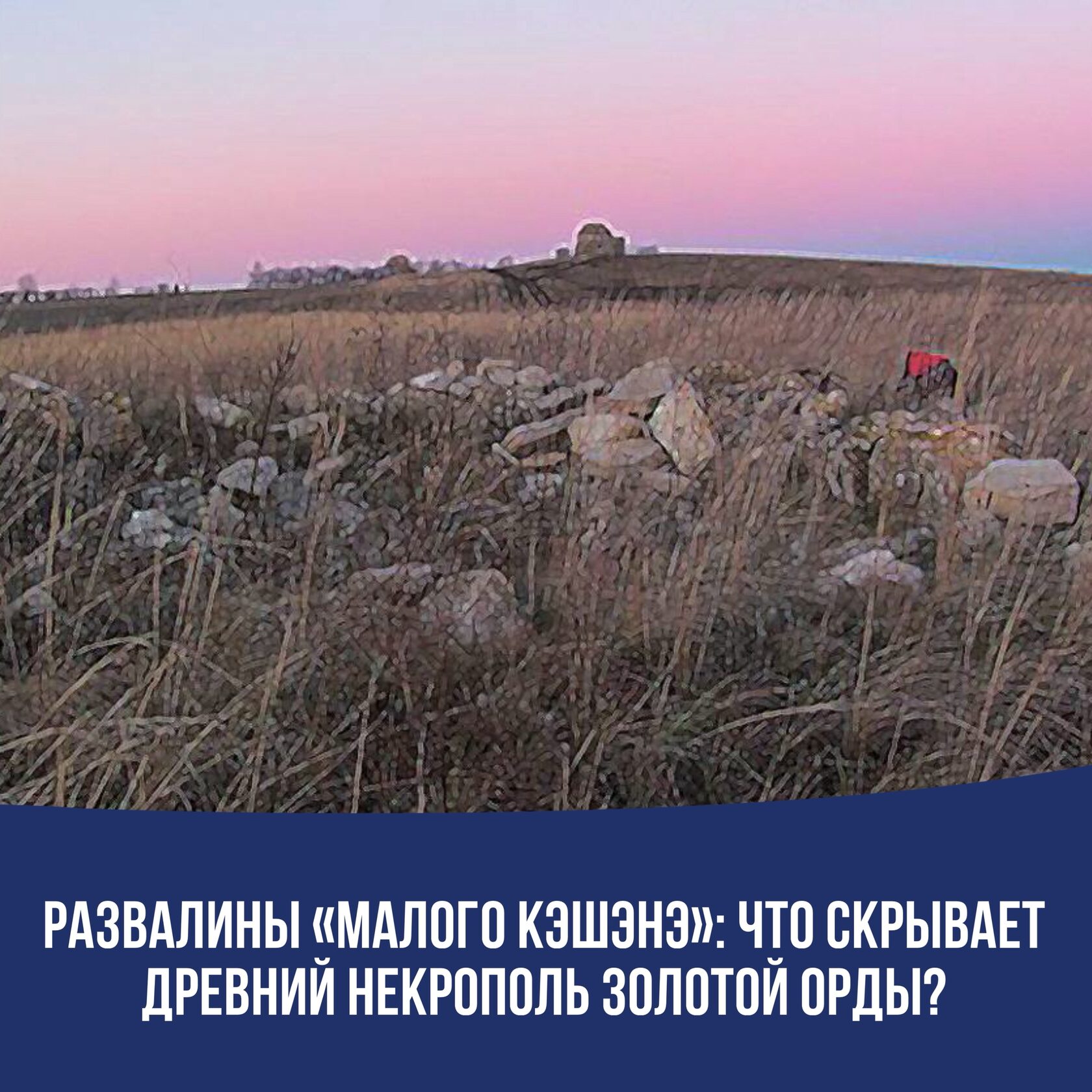
The Maly Keshene Mausoleum is one of the ancient monuments of the Golden Horde era in Bashkortostan. It is located next to the Tura Khan mausoleum and was probably part of a necropolis with many graves.
The walls of the mausoleum were thinner than those of the neighboring Tura Khan Mausoleum, and may have been built from less durable materials. The researchers suggest that the upper part of the walls could be made of mud bricks, which eventually collapsed. Only the stone plinths have survived to this day.
N.P. Rychkov in the XVIII century referred to the "Small Keshene" as "not quite built building." However, modern researchers, for example, G.N. Garustovich, believe that the mausoleum was completely destroyed. Perhaps the construction was interrupted due to political events, for example, due to the civil war in the Golden Horde (the "Great Jamming" of 1357-1380).
The mausoleum had a square shape and probably a centric layout. The walls were built of limestone slabs on gypsum mortar, and the dome may have been made of light volcanic tuff.
Maly Keshene is an important evidence of the spread of Islam in the Ural-Volga region and an example of Golden Horde architecture. Despite its poor preservation, it remains a cultural heritage site that helps us better understand the history of this region. Archaeological excavations by G.N. Garustovich, conducted in 1985, revealed four burials performed according to the Muslim rite, which confirms the religious function of the monument.
Source: Garustovich G.N., Nechvaloda A.I. Medieval stone mausoleums of Bashkortostan. Ufa, Kitap, 2020. 400 p.
The walls of the mausoleum were thinner than those of the neighboring Tura Khan Mausoleum, and may have been built from less durable materials. The researchers suggest that the upper part of the walls could be made of mud bricks, which eventually collapsed. Only the stone plinths have survived to this day.
N.P. Rychkov in the XVIII century referred to the "Small Keshene" as "not quite built building." However, modern researchers, for example, G.N. Garustovich, believe that the mausoleum was completely destroyed. Perhaps the construction was interrupted due to political events, for example, due to the civil war in the Golden Horde (the "Great Jamming" of 1357-1380).
The mausoleum had a square shape and probably a centric layout. The walls were built of limestone slabs on gypsum mortar, and the dome may have been made of light volcanic tuff.
Maly Keshene is an important evidence of the spread of Islam in the Ural-Volga region and an example of Golden Horde architecture. Despite its poor preservation, it remains a cultural heritage site that helps us better understand the history of this region. Archaeological excavations by G.N. Garustovich, conducted in 1985, revealed four burials performed according to the Muslim rite, which confirms the religious function of the monument.
Source: Garustovich G.N., Nechvaloda A.I. Medieval stone mausoleums of Bashkortostan. Ufa, Kitap, 2020. 400 p.